Let , recall that and by definition we know that , which we can think of as all multiples of . Now then , for some fixed we can see that
We'll start by showing that the two sets are equal, so let then for some , now consider the equivalence class , it is defined as all elements in who all share the same remainder as upon division by , as previously seen it turns out that this set is equal to but this is exactly , as needed.
Now suppose that we have some , as just discussed we know that which is the coset . Thus at this point we concluded that as sets, we have
Suppose that then , but at the same time and and we have which shows us that their addition operations are the same because , it's similarly noted that their multiplications are the same by replacing respective plusses with the times symbol.
Therefore given these two rings, both of their sets are equal and their operations are equal, so they are actually the same ring.
- Find a polynomial with degree that is congruent to modulo
- Prove that and are zero divisors in
To find a polynomial with the same remainder we first do things via long division:
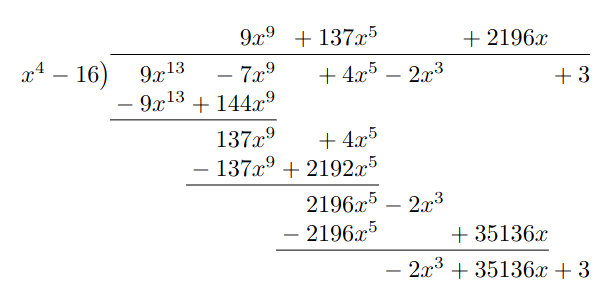
Therefore the polynomial is congruent modulo , because they both have the same remainder upon division by .
Recall the definition of a zero divisor, note that in this quotient ring is simply the polynomial with all coefficients set to , therefore we can clearly see that have at least one non-zero coefficient therefore they cannot be zero elements. Now at the same time we can factor . We get two equations from this : and , since we can verify that are both non-zero polynomials, then so far we can conclude that
Now notice that . For convience set So then we have that and also that
- Find the gcd of and as elements of and express it as a linear combination of and
- Do the same in
We start by finding the gcd in by using the euclidean algorithm:
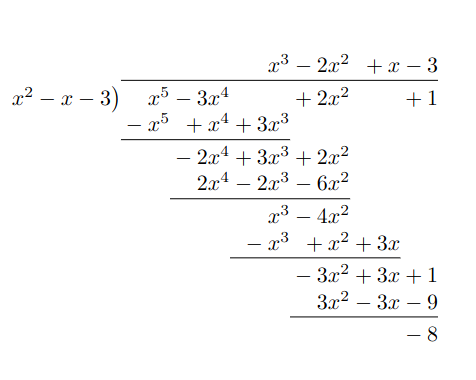
Therefore we conclude that , therefore we know that their gcd is one, we can express the linear combination as
Now we do the same in , but since in the above long division we never used any inverses, or elements that cannot be represented in (we can see 6 as 1 here), then we get the same answer, but we can re-write as , so we
Consider the map defined by , note that the domain is correct because for any , so therefore for some . Moreover see that it is a homomorphism quite easily by verifying multiplication, addition and that clearly it maps to .
Additionally this map is surjective because given any we see that the polynomial will map to it under , this means that , with that knowledge therefore we have that
We'll now prove that . Starting with recall that are all the multiples of , moreover therefore , since any element of is a multiple of then by taking an arbitrary element from it, it must be of the form where but since is a homomorphism, then we know that , thus .
Now approaching the other inclusion we suppose we have some , clearly if tne on the other hand if is a constant other than zero, then also therefore we may assume that is non-constant, in such a case we know that either or that .
Suppose that therefore we get polynomials such that but then which is a contradiction, and therefore we must have that so that is a multiple of , in other-words
- Show that is a maximal ideal
- What is the gcd of and in
Note that doesn't have any roots because of the following facts
Therefore since it's degree is 2, then we can conclude that is irreducible, which implies that is maximal.
As we look to find the gcd, we just observe the following simple calculation Therefore we have that So that the gcd is also one. This allows us to conclude that is the multiplicative inverse of in
We'll note that since is of degree 3 and has no root in because , , therefore is irreducible. Therefore is a field.
Note that is possible that the equation we wrote down doesn't specific that is a function, so let's determine that first. That is, we must verify that our function doesn't every map one thing to two different things. So suppose that we have where , and note that this is only true when , since , then also we conclude that , meaning that , therefore , so we know that indeed is well defined.
Now we continue by showing that it's a crone homomorphism, so we see the following So that respects addition, and also that so that respects multiplication, and then we note Thus we conclude that is a crone homomorphism.
Let's first look at what it means to be an irreducible polynomial in , for any polynomial with degree greater or equal to we know that by the fundamental theorem of algebra it has exactly two roots, and that can be used to re-write that polynomial as a product of two polynomials in which means by definition none of these polynomials are irreducible. This only leaves polynomials of degree one in each of which are irreducible over .
Therefore we can now conclude that is a polynomial of degree , so that it is a linear polynomial, therefore by the prvious exercise we conclude that
In our given question plays the role of and that of . If we consider the family of ideals in since is irreducible in , then we know that this quotient is a field, and thus only has two trivial ideals, (everything and just zero) which correspond to and , thus those are the only ideals which contain .
- Let and consider the field with 4 elements . We know is a root of . Show that contains the other root of as well.
- Let and consider the field . Note that the map defined by is an isomorphism of the two fields. Recall that does not contain the other two roots of since they are non-real complex numbers while . Prove that does not contain any other root of other than . Hint: use the isomorphism
For the first part, we'll notice that if is a root then we know that , but on that same thought we also note So that also contains the other root of
For the second part we set for convience. Now note the following factorization Therefore if has some root of other than , then it must be a root of , but we can compute the roots of this polynomial via the quadratic equation, which yields and therefore we see these roots are in , therefore there are no other real roots other than in .
Now recall that a quadratic polynomial over any field has no roots in iff it is irreducible in , and that is preserved over isomorphisms of with another field. Now observe that through we can verify that this bijection forms a homomorphism, and thus is an isomorphism, so that and are isomorphic, and therefore doesn't contain any other root of
- Determine the number of irreducible polynomials over of the form . Hint: start by finding the number of reducible polynomials over of the form .
- Determine the number of irreducible quadratic polynomials over . Hint: how is this question different from part (a)?
If , then we know that which is not solvable in , however given then we have that which is also not solvable in , so that there is no element in that is a root of
We show that they are not isomorphic by contradiction, so we suppose that they are isomorphic and see what happens, if they are isomorphic, then we have
but then is an element of which is a root of which is clearly impossible, so no such isomorphism exists.We a-priori know that is trancedental. We also know that .
Assume for the sake of contradiction that with numerator and denominator of degree respectively , therefore with , so that by re-arranging we can obtain this form this is a polynomial of degree either or , but in either case, it is a non-zero polynomial, because the coefficient on this term is non-zero as stated earlier.
But this would imply that is a root of the polynomial obtained by syntactically replacing every with in the above expression and interpreting it as that as a polynomial, which would imply that is algebraic, which it is not. Therefore
- Describe the elements of . Hint: recall that is the smallest subfield of containing and .
- Let . Show that is a finite dimensional vector space over by showing that is a basis for over . Is an algebraic extension of ?
A transcendental number is a real or complex number that is not algebraic, that is to say it is not a root of a non-zero polynomial of finite degree with rational coefficients. Suppose that is transcendental over .
Consider the map so that for any we have
Let , then which follows from basic facts about finite summations. Additionally we have that which follows from the definition of polynomial multiplication (which holds when holds a real number). Finally since there is no varaible to evaluate, so that is a homomorphism.
Note that the kernel of is empty, for if an element were to be in the kernel then would be a root of that polynomial, which is impossible because is transcendental. Therefore by the first isomorphism theorem we have an isomorphism between and . That is to say that 's elements are fully described by elements, which are polynomials with rational coefficients. We also know , which is another way of describing the elements of .
Moving onto the next question, let's observe that is a field extension, and that , note that is a monic polynomial in such that is a root, therefore is algebraic over .
We can also observe that is irreducible in this follows from what we showed earlier and then we have that As seen earlier can be viewed as a vector space over with a basis given by . Now the isomorphism between these two structures is actually defined pointwise as , in other words we obtain that a basis for is through this isomorphism.
Let be the splitting field of over , note that is a field extension of . Since splits here, then also contains all the roots of .
Observe that are roots of , and that they reside within as well, this is seen because since is a field extension of then and therefore as it's a field.
At this point we want to claim that is a splitting field for , but to do that we need to show that there is no proper subfield in which splits. For the sake of contradiction, if there was, then we'd have a problem because we could use this proper subfield as a splitting field for by a similar argument, which contradicts the fact that was a splitting field.
For the reverse direction, a symmetric proof may be obtained.
We start by observing the following factorization:
By brute force, we can observe that there are no roots to the polynomial in , therefore it is irreducible, so that we obtain the field extension that contains a root , we can see that and also that since it's a root we have that , but then also that so then is a different root, therefore contains all roots of so that it must split here, specifically we know is the split.
Now we have to prove that there is no proper subfield of such that splits, this follows from the fact that it's a degree 2 extension and that 2 is prime in conjunction with the degree division formula. Thus we've shown that is indeed the splitting field of as needed.
- for every having as a root
- is the only monic polynomial in of degree that has as a root
Let , then we know that We first show that the collection is linearly independent. For contradiction, suppose we had some index set such that but this equivalently states that is a root of the polynomial we just constructed, that is , but then we've found a polynomial with degree at most that also has as a root which is a contradiction based on this fact , so that we cannot have such a sum being equal to , therefore is linearly independent.
On the other hand, we can show that indeed spans , to see this note that any given element in is of the form , and that by the division algorithm we may obtain such that where , which means that every element in is a polynomial of degree at most , and can be obtained by taking a linear combination from the collection and recalling that .
Thus we conclude that is a basis for as needed.
We first start by looking at monic polynomials, so they are of the form that of which there are by iterating through all possible values for .
Now given such a polynomial, we know that it is reducible if it can be factored into linear terms of the form where each of which gives rise to which is uniquely associated with this factorization. With that said, there are such factorizations, each of which yields a unique reducible polynomial. Thus we conclude that the number of irreducible monic polynomials is given by
Now if we want to know the number of irreducible quadratic polynomials over which aren't necessarily monic, we can realize that that such a polynomial is of the following form where and is irreducible in , that of which there are , thus for each such choice of , which there are choices of we obtain a unique irreducible polynomial, and therefore there are many irreducible polynomials.
We'll use the cubic formula to determine the roots, let's start with because it's in the correct form.
Let's recall that the roots of a polynomial of the form are given by the following
Such that:In our question and so let's start by computing , let therefore and thus , thus our roots are given by
We now move our attention to which is not in the correct form to apply the cubic formula, although we do have a method to deal with this, so we employ it.
In our case and so therefore we turn our attention to the polynomial
Let's break down first: Now we can try
Now back to computing we have Now our equation has the correct form to be able to apply the cubic formula and so we can do that, suppose we obtain roots , then the roots of are given by
- Show that is irreucible over
- Show that every element of the field is of the form with . We know that is a root, so that we can write . Show that is a basis for as a vector space over
- Since is a root of , we know for some , find
We can show that is irreudcible in a few ways, the first way is by using the the rational roots theorem to find the possible candidates for roots are none of which work, so we know that the only possible factorization is by a degree 2 polynomial and a degree 3 polynomial, we can use the gauss theorem to show that is irred in iff is irred in because the gcd of all of it's coefficients are 1, which means that is primitive. We proceed by then writing out a degree 3 polynomial times a degree 2 polynomial with variable coefficents and find that no such coeffients exists.
The above method works out, but I found an interesting irreducibility test that I found was interesting. It's called the Cohn's irreducibility criterion which states that:
Assume is a natural number and is a polynomial such that . If is a prime number then is irreducible in
Applying that to our polynomial, we observe that must be true so that , by plugging in we see that which is a prime number, and therefore is irreducible in then by gauss it is irreducible in .
Looking at the next question we recall that we've proven this fact after observing this proof we note that clearly by the division algorithm we have that every element in must be a coset of a polynomial of degree at most four, as a direct consequence we also note that is a basis for over
We divide by to obtain